
GRAMMAR REVIEW - Week 7 - Past tenses and modals
Overview of tenses in English (Present and past)
|
Tense |
Construction |
Example |
Main value(s) |
|
Simple present |
V (+3rd person –s) |
I play the guitar He plays football. |
_ characteristics, generalities _ habits |
|
Present continuous |
Am/is/are + V-ing |
He is eating |
_ ongoing activities _ description and comments |
|
Simple past (=preterite) |
V + -ed (except irregular verbs) |
They visited |
_ break with present _ completed action _ dated, sequential events |
|
Past continuous |
Was/Were + V-ing |
We were talking when … |
_ interrupted activity _ “background”, context |
|
Past perfect
|
Had + V-en |
The man they had seen … |
_ past in the past, flashback _ assessment in the past |
|
Past perfect continuous |
Had been + V-ing |
We had been watching Tv for 2 hours when… |
_ idem + activity |
|
Present perfect
|
Has/Have + V-en |
We have lived her for 10 years |
_ link with the present _ assessment in the present |
|
Present perfect continuous |
Has/Have been +V-ing |
They have been fighting for their rights for 10 years. |
_ idem + activity |
1) Remember !!!
_ there is no direct equivalence between French and English tenses!
Ex: Ils sont arrivés aux USA en 1620 => They arrived in 1620. (The event happened in the past)
And vice versa : They have lived in Massachusetts for four centuries now. => Ils vivent aux Massachusetts depuis quatre siècles. (En français, “ont vécu pendant…” = ils n’y habitent plus!)
– passive does not mean past! The passive voice is not a tense but a different way to look at the action, and can be combined with all of the tenses above!
The passive always requires BE (conjugated in the appropriate tense) + V-en
ex: They had been persecuted
1) Practice conjugating the verbs as indicated:
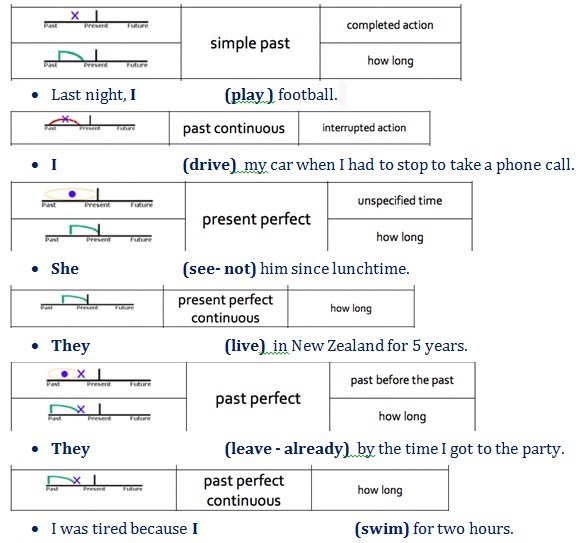
ANSWERS:
played / was driving /has not seen /have been living /had already left /had been swimming
=> REVIEW EXERCISE: exercise Week7 Tenses
=> IF YOUR SCORE WAS LOWER THAN 90% ON THESE EXERCISES, READ MORE AND DO ADDITIONAL EXERCISES:
English grammar in use (with answers) [425 MUR] (+ CD-ROM in Centre de Langues Salle Multimedia)
Present and past (Units 1-6); Present perfect and past (Units7-16)
Grammaire raisonnée 2 [425 PER] (livre + livret de corrigé des exercices)
Chapitre 1 – Temps et aspects
MODALS - Review
1) Rules – Construction:
- Modals are followed by an infinitive (but without the preposition to): He must to go.
- You cannot add a 3rd person –s ! (cans)
- A modal cannot be followed by a conjugated verb ( “can’t lived”!)
- You can’t use two modals in a row (“must can”!)
2) Value – what they mean. Compare these sentences
a) He has such a big house. He must be very rich!
b) You must follow the instructions.
In sentence b), “must” expresses an obligation. => It is a ROOT modal
In sentence a), “must” is used to make a hypothesis. => It is an EPISTEMIC modal
A) Epistemic modals express a degree of probability; we can rank them as follows:
Can’t 0% > Might, Could 25% > May 50% > Must, should 90% > Will 100%
impossible = can’t/ somewhat possible = might/ quite possible = may/ almost certain = must / certain = will
To make hypotheses about the past, use modal + have + past participle
They must have left (ils doivent être partis)/ He can’t have killed her (il ne peut pas l’avoir tuée).
B) Root modals give information about the subject (ex: capacity) or express interpersonal constraints
|
Modal |
Value |
Negation |
Value |
|
Can |
1) Capacity, Ability 2) Permission |
Can’t |
1) Incapacity 2) Prohibition |
|
May |
Permission |
May not |
Prohibition |
|
Must |
Obligation |
Mustn’t |
Prohibition |
|
Should |
(Strong) recommendation |
Shouldn’t |
Recommendation not to do something |
NB: If you want to express an absence of obligation, you need to use “don’t have to” (not mustn’t!)
Since most modals do not have past forms, you will need to replace them with equivalents.
|
Modal |
Value |
Negation |
Value |
|
Can |
1) could, was/were able to 2) could, was/were allowed to |
Can’t |
1) couldn’t, wasn’t/weren’t able to 2) couldn’t, wasn’t/weren’t allowed to |
|
May |
Might |
May not |
Mightn’t |
|
Must |
Had to |
Mustn’t |
Wasn’t/weren’t allowed to |
NB: might and mightn’t are quite formal, so are less frequent than could(n’t) or was(n’t)/were(n’t) allowed to
=> EXERCISE: exercise Week7 Modals
=> IF YOUR SCORE WAS LOWER THAN 90% ON THESE EXERCISES, READ MORE AND DO ADDITIONAL EXERCISES:
English grammar in use (with answers) [425 MUR] (+ CD-ROM in Centre de Langues Salle Multimedia)
Units 26-34 (modals –select the appropriate unit)
Grammaire raisonnée 2 [425 PER] (livre + livret de corrigé des exercices)
Chapitre 4 – la modalité